PRJ_018 // AI_DEVTOOL

ModSmith

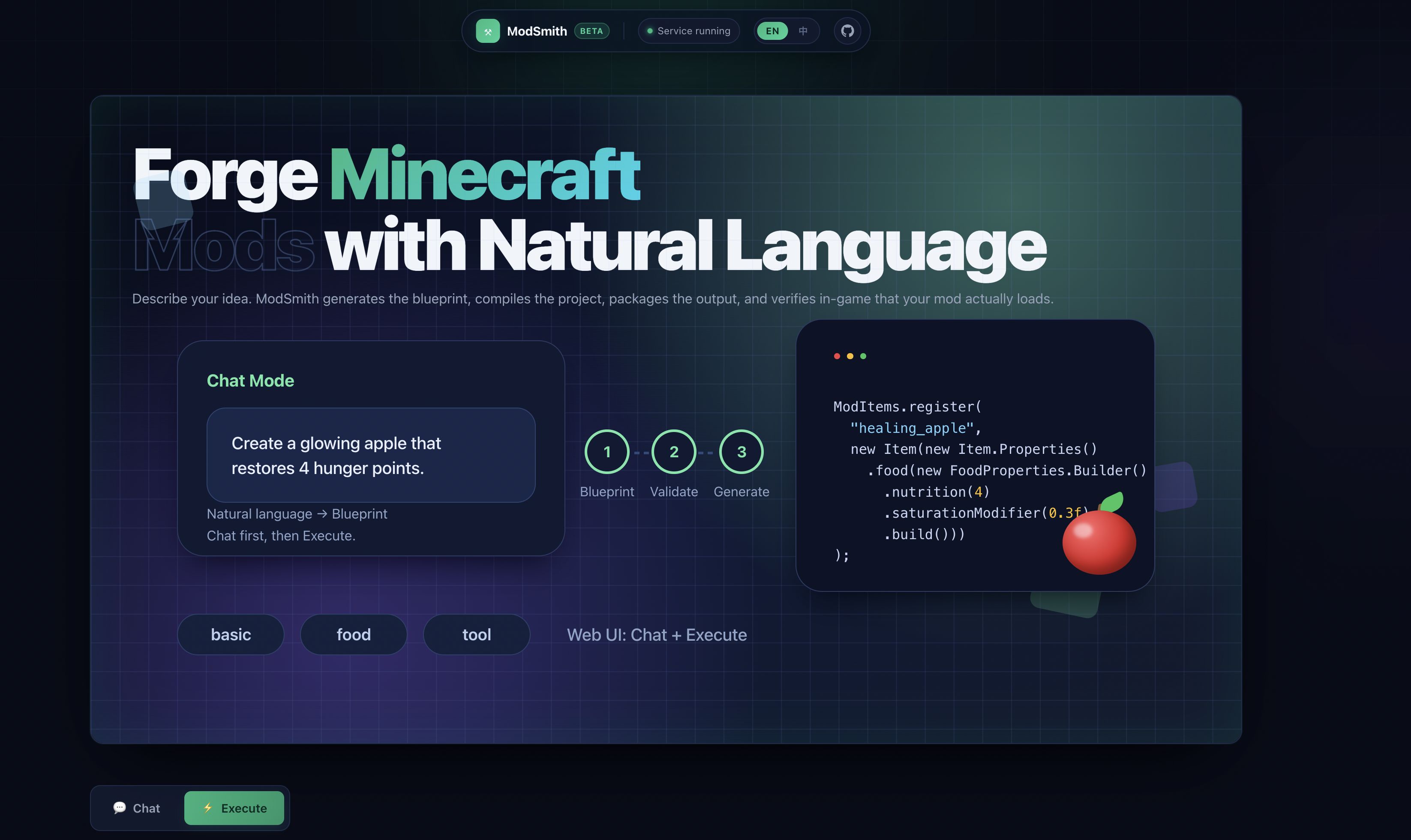
Describe your idea. ModSmith generates the blueprint, compiles the project, packages the output, and verifies in-game that your mod actually loads.

AI DevTool Minecraft Modding Full-Stack
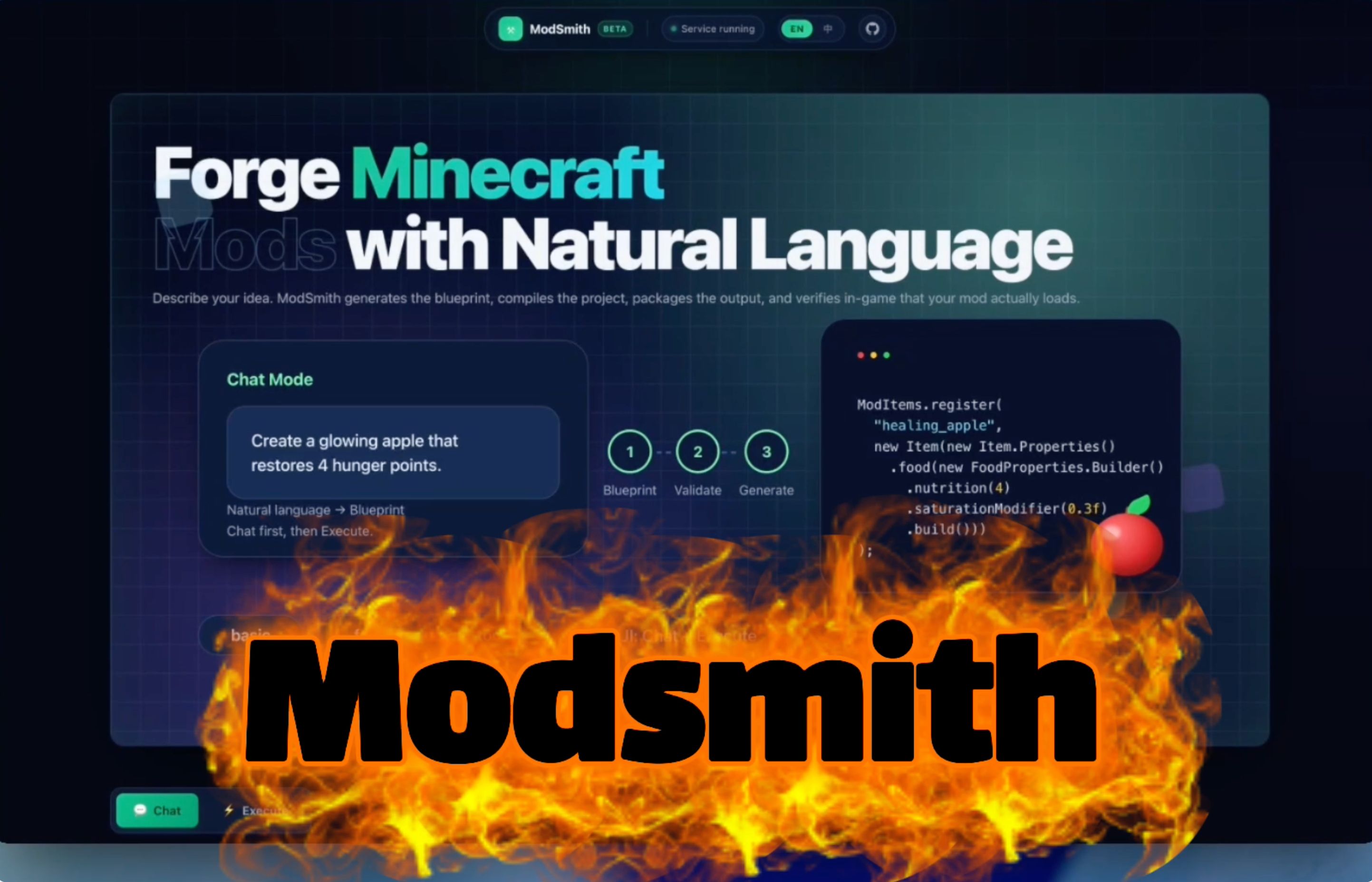
ModSmith landing page

Overview

ModSmith landing page

ModSmith is an AI-powered Minecraft mod generator. You describe what you want in natural language — "a glowing apple that restores 4 hunger points" — and the system translates your idea into a fully compilable, installable Minecraft Fabric mod.

The core design decouples "user intent" from "code implementation": the LLM only translates natural language into a verifiable JSON blueprint, then deterministic templates generate the actual Java source and resource files. This approach is predictable, verifiable, and rollback-safe. Two layers of verification — compile-time and runtime — ensure the generated mod actually works before it ever reaches the player.
Motivation — From Envy to Action

I grew up playing Minecraft and always admired modders who could turn their ideas into real in-game items. I wanted to do the same, but every time I opened a tutorial I hit a wall: Java, Gradle, Fabric API, resource pack formats — the learning curve was overwhelming, and I never knew where to start.

Then, at an MBZUAI admissions presentation, I heard about a senior's startup called ModCraft that could generate publishable mods from natural language. I was fascinated: how was this possible? Back home, I thought — I don't know much Java, but in the AI era anything seems possible. Could I build something similar myself?

So I started ModSmith. The goal was not to replace mod developers, but to let anyone with an idea — even without Java knowledge — turn that idea into a playable mod.

Learning Path — Hand-Coding First, AI Second

ModSmith — Hand-Coding First, AI Second

I read an article on the Fabric Wiki titled "Using LLMs for Minecraft Modding". It warned that beginners should not let LLMs write mods from scratch — you would miss the practice and have no ability to judge whether the AI-generated code is correct.

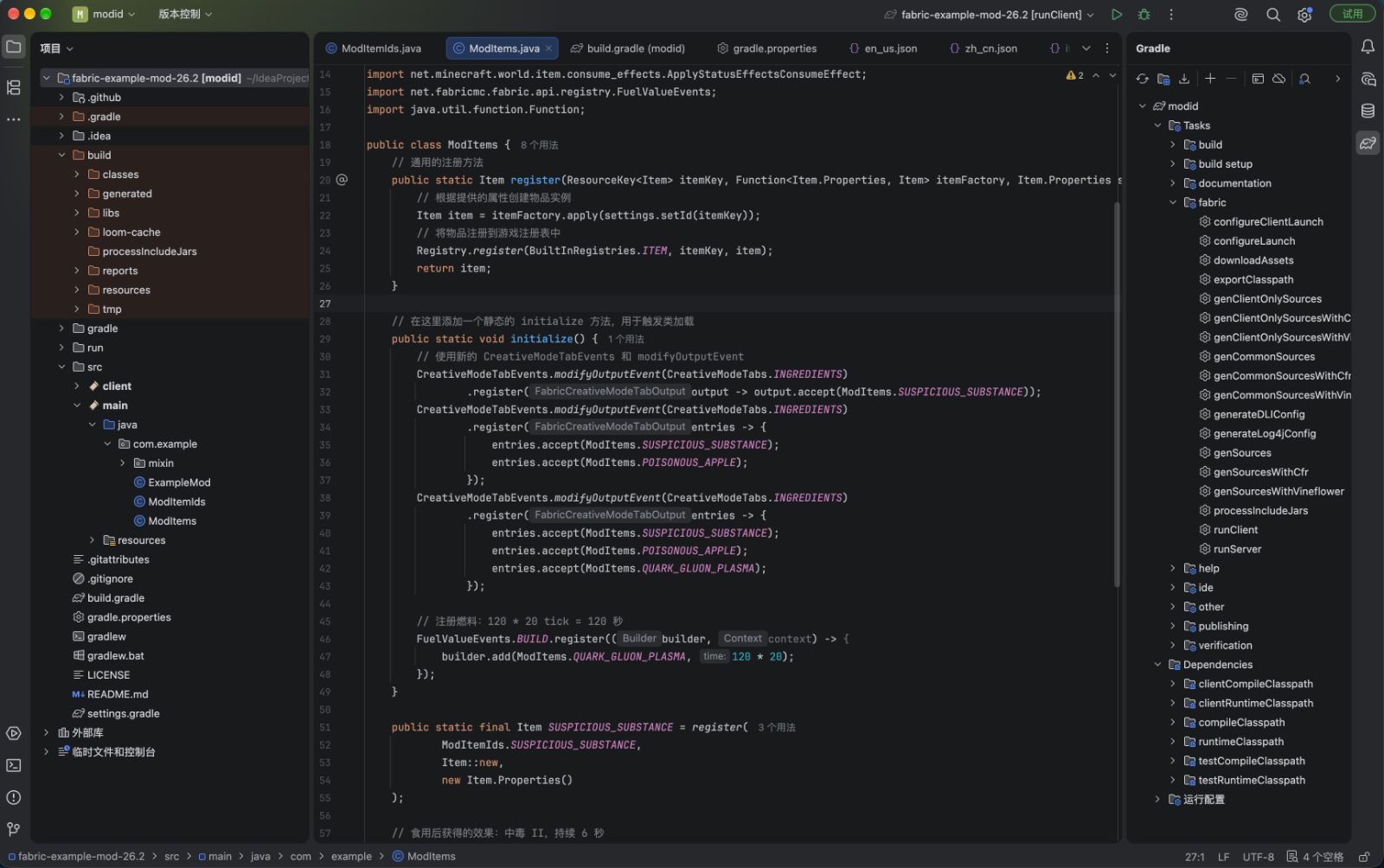
So I took the long route first. I taught myself IntelliJ IDEA and Java, then worked through the official Fabric tutorial manually. By typing every line myself, I understood the registry system, the relationship between Item and Item.Properties, the structure of resource packs and model JSONs, Gradle build flows, and the API differences between Minecraft versions.

Only after I had that foundation did I bring in AI. With the ability to judge correctness, I could now use LLMs as a multiplier instead of a crutch.

Architecture & Implementation

The system architecture is built around a clear separation of concerns: LLMs handle the "what" (translating intent into a structured blueprint), while hand-written templates handle the "how" (generating compilable Java and resources). This keeps generation deterministic and debuggable.

📝

Blueprint Generation

LLM translates natural language into a verifiable JSON blueprint — structured, typed, and easy to validate before any code is produced.

🔧

Template-Based Codegen

Deterministic templates convert blueprints into Java source files, model JSONs, texture stubs, and Gradle build scripts — no "creative" code generation.

✅

Compile Verification

Auto-runs ./gradlew build. Failures are fed back to the LLM to correct the blueprint, with up to 3 retry cycles.

🎮

Runtime Verification

Launches Minecraft, parses game logs, and checks that the mod loads and items register correctly — proof that it actually works.

Two Modes — Chat & Execute

The web interface offers two distinct modes for two different workflows:

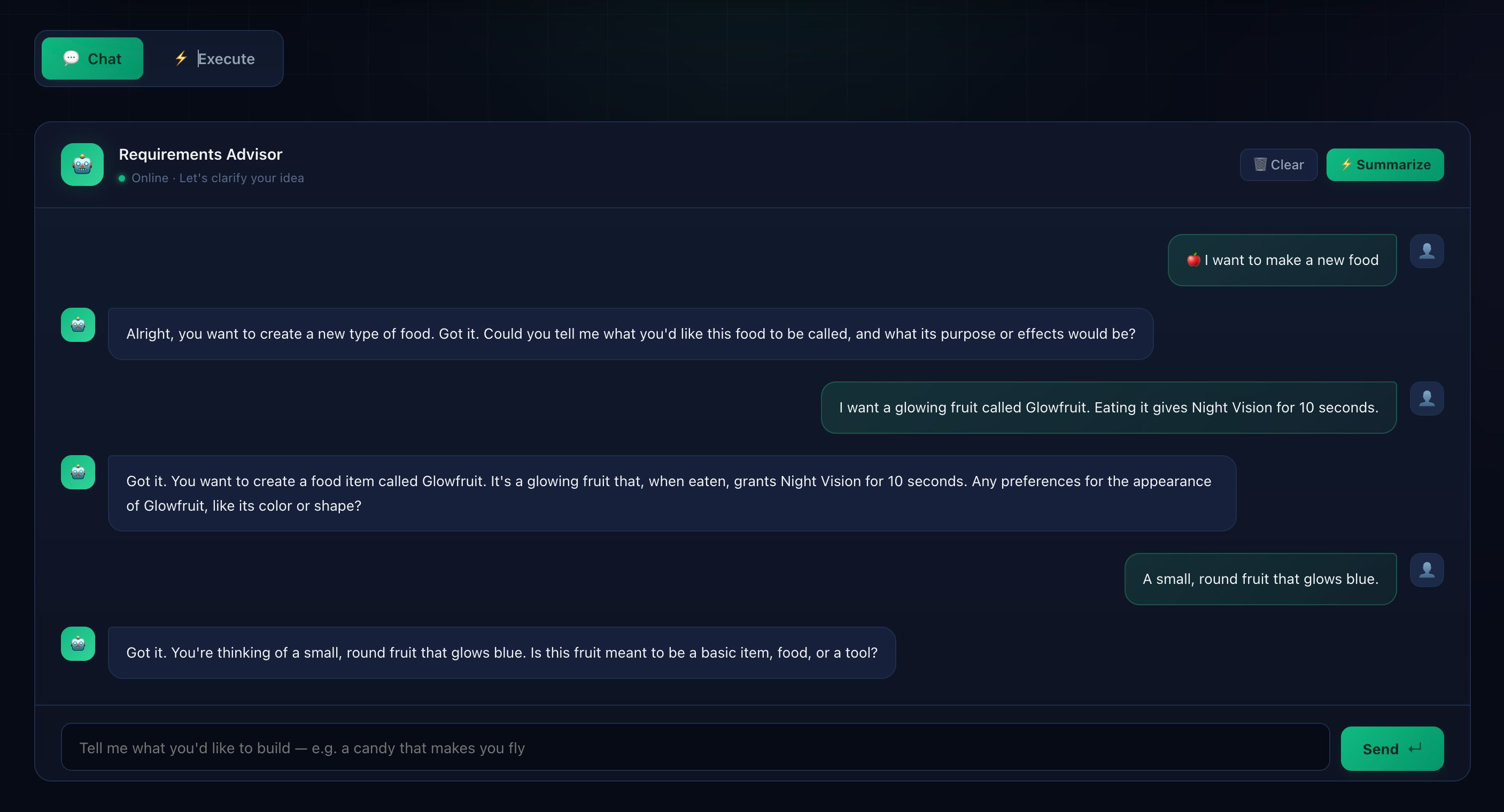
Chat Mode for iterative requirements clarification, powered by a Requirements Advisor agent that asks follow-up questions until the intent is fully specified;

ModSmith chat mode with requirements advisor

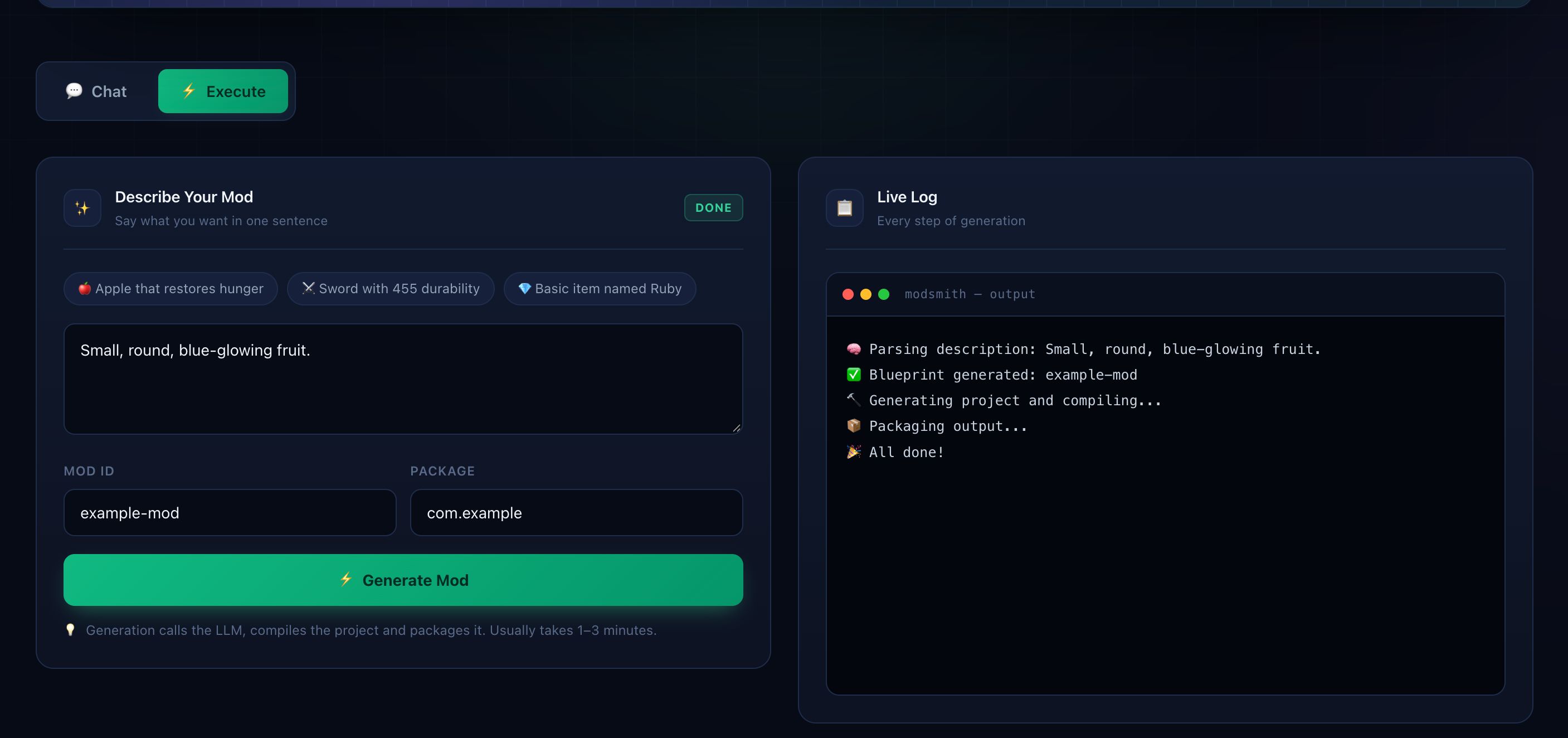
and Execute Mode for one-shot generation with live progress logging, so you can watch each stage — blueprint, codegen, build, verification — as it happens.

ModSmith execute mode with live log

Users can generate basic items, food items, and tools — each with their own template pipeline. The same blueprint drives both modes, so a spec refined in Chat Mode can be handed straight to Execute Mode without rewriting anything.

Generated Content & In-Game Proof

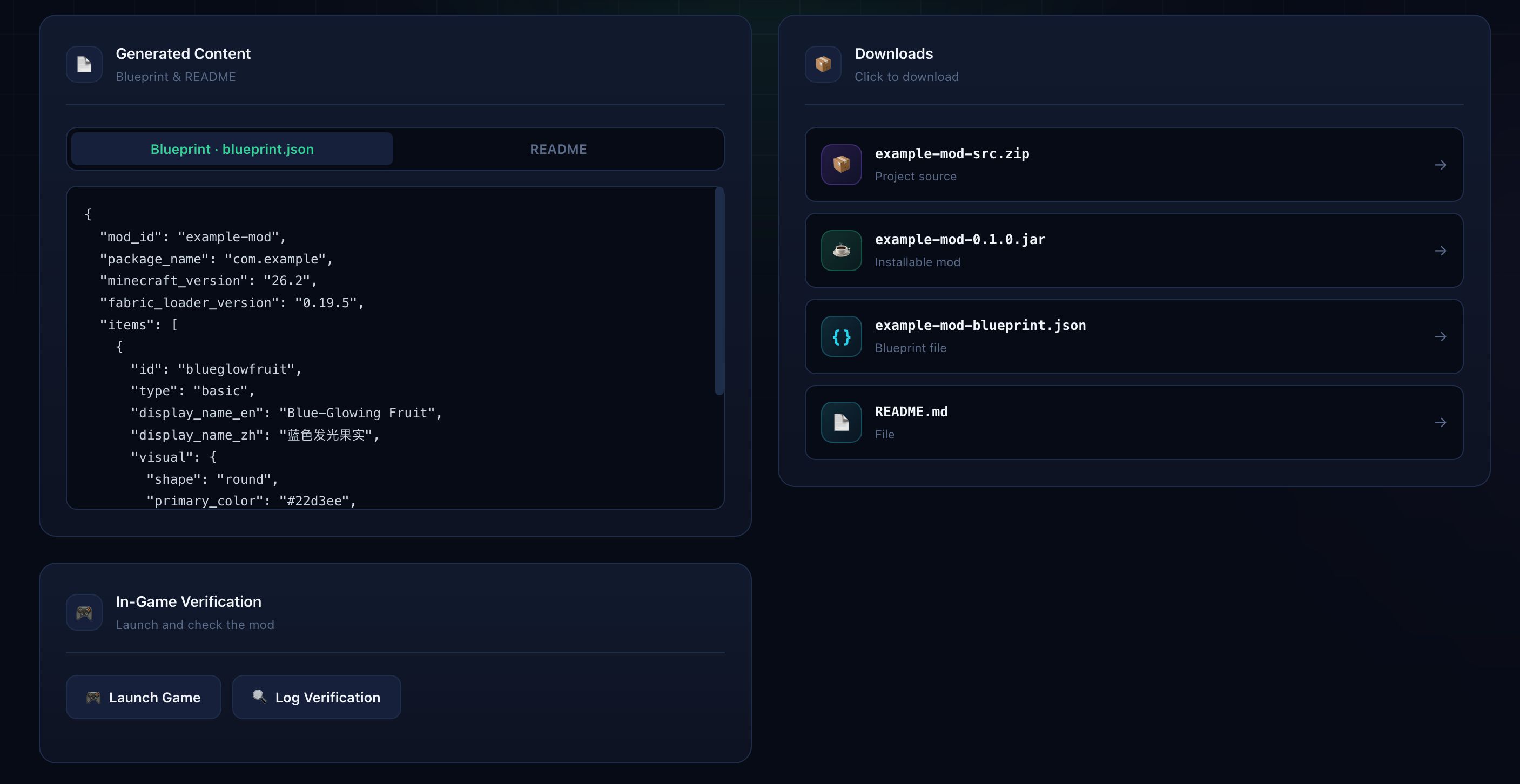
ModSmith generated content and downloads

Every successful generation produces four downloadable artifacts: the full project source (ZIP), the installable mod JAR, the blueprint JSON for reproducibility, and a README with installation instructions. The generated content panel shows the complete blueprint with all item properties, visual settings, and localization strings.


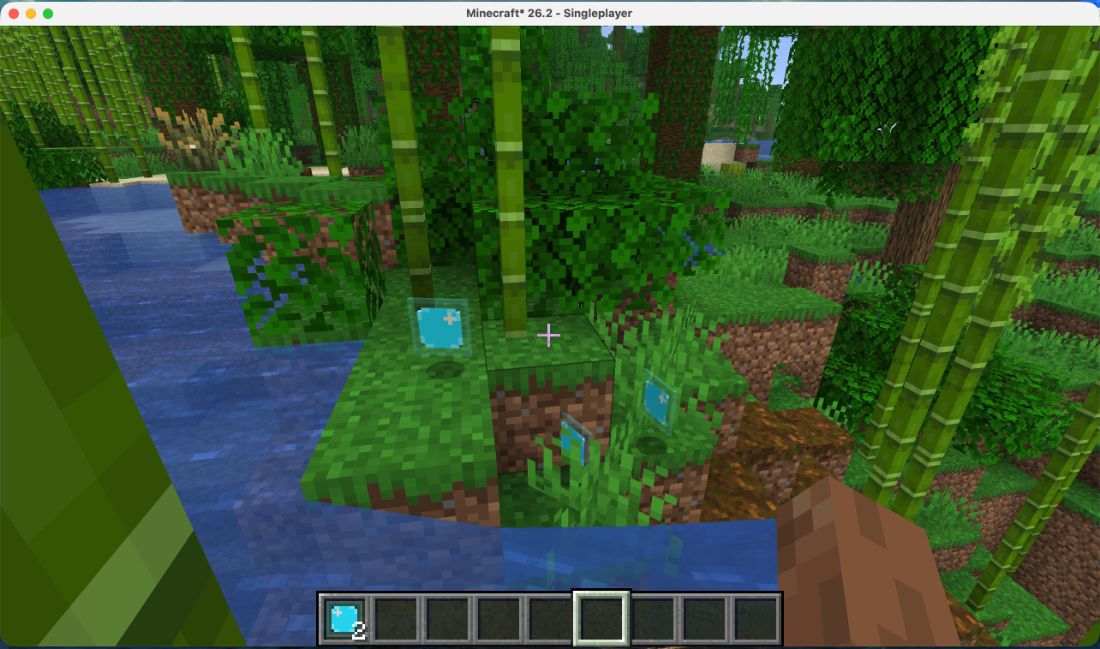
Minecraft in-game verification screenshot

The ultimate test: launching Minecraft and seeing the generated item appear in the inventory. The in-game verification panel shows live log output from the game launch, confirming that the mod loads without errors and the custom items are registered. In the screenshot above, the "Blue-Glowing Fruit" (generated from the description "Small, round, blue-glowing fruit") is visible both in the inventory slot and as a dropped item in the world.

Reflection

Building it also taught me that "I don't know Java" is no longer a hard blocker. With the right architecture — templates for structure, AI for translation, verification for safety — you can build tools that let anyone create in domains that previously required years of training.

THE SHIFT What building ModSmith taught me about ability in the age of AI. THEN · TRADITIONAL ABILITY KNOW HOW + DO IT YOURSELF Craftsmanship · Hands-on Execution NOW · AI-ERA ABILITY DEFINE “GOOD” + VERIFY IT TRULY IS Requirements Architecture · Cognitive Audit evan.dev · ModSmith Reflection · 2026
LLM-Powered Blueprint Architecture Dual Verification