PRJ_016 // GAME_DESIGN

Rotating Tetris

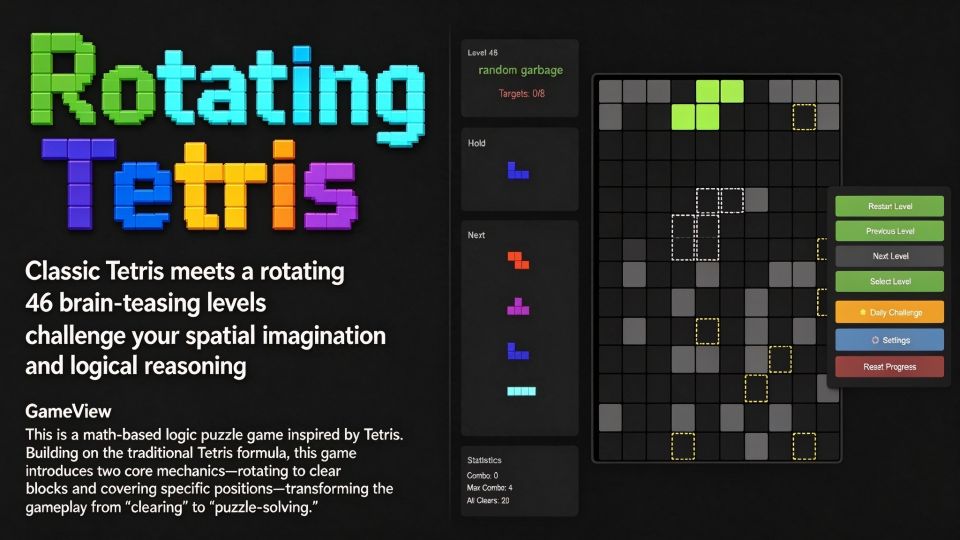
Classic Tetris meets a rotating twist. 46 brain-teasing levels challenge your spatial imagination and logical reasoning.

Puzzle Logic Strategy Level Design
Rotating Tetris Gameplay

Overview

Rotating Tetris is a math-based logic puzzle game inspired by the classic Tetris formula. It introduces two core mechanics—rotating to clear blocks and covering specific positions—transforming the gameplay from simple "clearing" into deep "puzzle-solving."

With 46 meticulously designed levels progressing from easy to hard, the game gradually guides players to master techniques such as rotating, covering, and building bridges between blocks to reach designated goals.
GameView

Rotating Tetris Overview

This is a math-based logic puzzle game inspired by Tetris. Building on the traditional Tetris formula, the game introduces two core mechanics—rotating to clear blocks and covering specific positions—transforming the gameplay from "clearing" to "puzzle-solving."

Players are given a set of blocks and must observe carefully, calculate in advance, and plan their sequence. Building temporary bridges between blocks may be necessary to help other blocks reach target positions, demanding strong spatial imagination, logical thinking, and spatial calculation skills.

46 Levels

Rotating Tetris Level Select and Progression

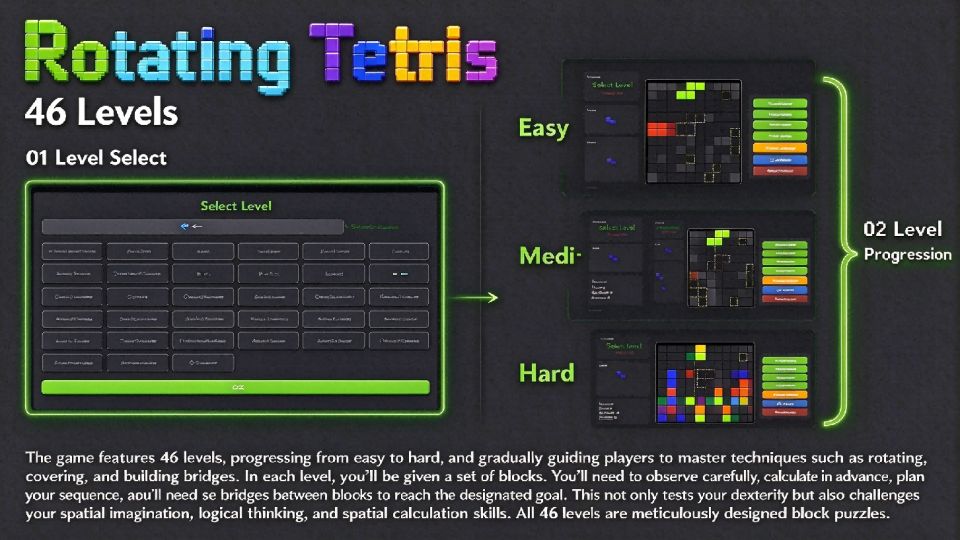
The game features 46 levels, progressing from easy to hard, and gradually guiding players to master techniques such as rotating, covering, and building bridges. All 46 levels are meticulously designed block puzzles.

🟢

Easy

Introductory levels that teach the core mechanics. Players learn how to rotate blocks and cover target positions with straightforward puzzles.

🟡

Medium

Intermediate challenges that require planning multiple moves ahead. Block allocation and move order become critical to success.

🔴

Hard

Advanced puzzles demanding strong calculation, analysis, and spatial imagination. Players must build temporary bridges and dismantle them to help other blocks reach target positions.

Core Mechanics

Rotating Tetris transforms the classic formula by introducing puzzle-solving objectives:

🔄

Rotate to Clear

Unlike traditional Tetris where lines clear automatically, players must strategically rotate and position blocks to clear specific target areas. Every rotation matters.

🎯

Cover Specific Positions

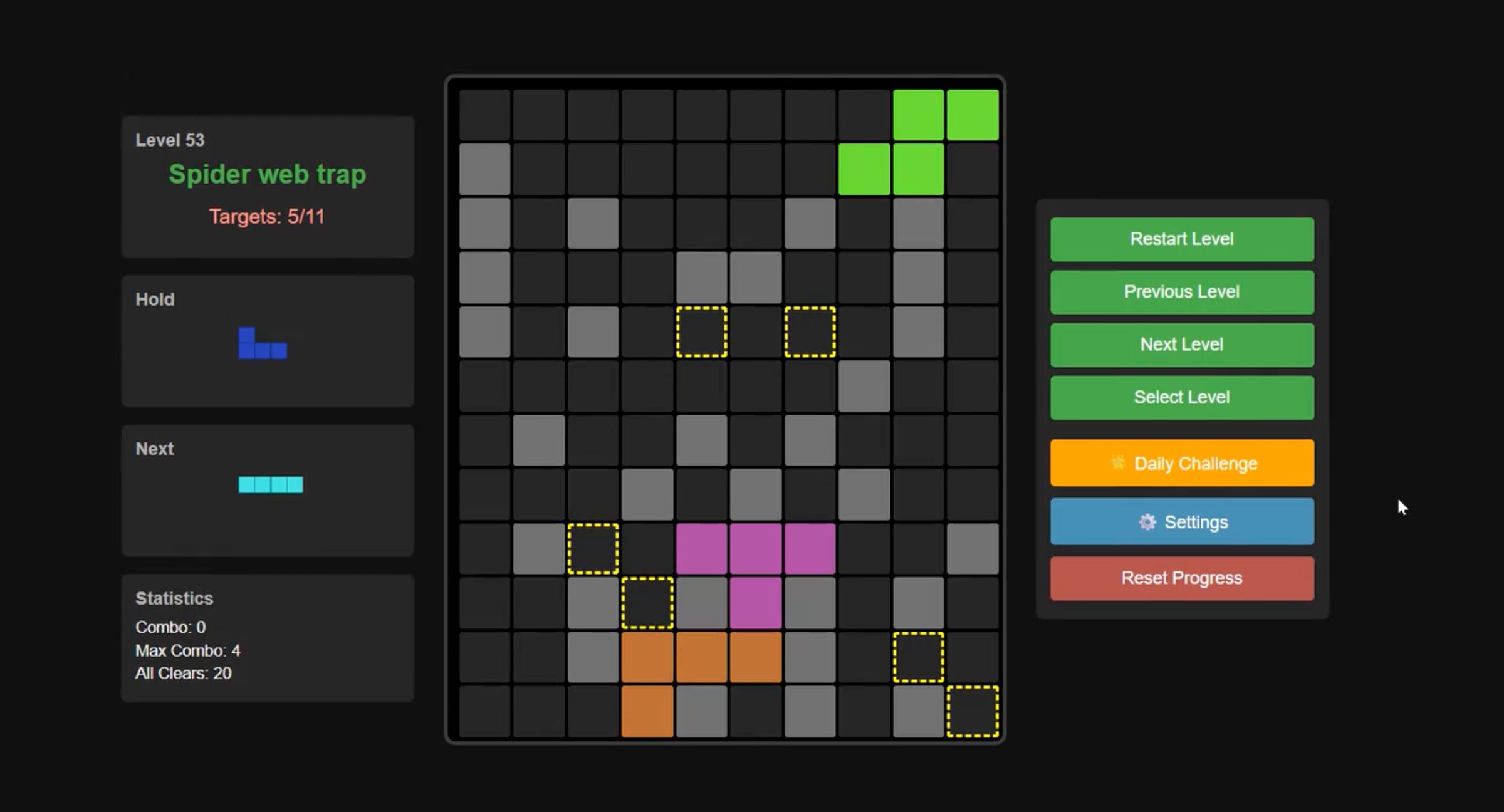
Each level presents yellow target cells that must be covered by blocks. The challenge is not just clearing lines, but precisely covering designated positions with the given pieces.

🌉

Build Bridges

Advanced levels require building temporary bridges between blocks—placing pieces to help other blocks reach target positions, then dismantling the bridges. This adds a layer of multi-step planning.

Development Challenge

Rotating Tetris Difficulty Analysis and Development Simulator

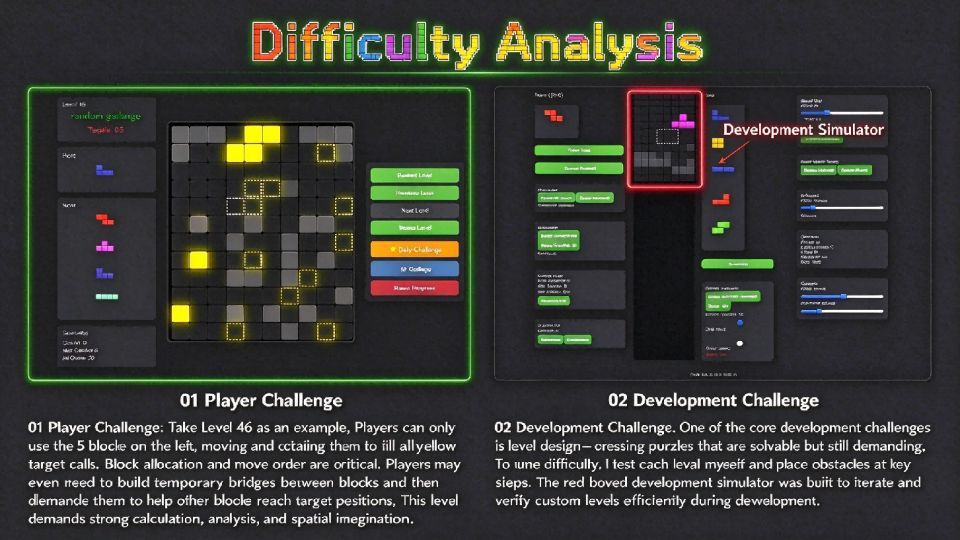
One of the core development challenges was level design—creating puzzles that are solvable but still demanding. To tune difficulty, each level was tested manually and obstacles were placed at key steps.

🧩

Player Challenge

In the hardest levels (e.g., Level 46), players can only use the blocks provided, moving and rotating them to fill all yellow target cells. Block allocation and move order are critical. This demands strong calculation, analysis, and spatial imagination.

⚙

Development Simulator

A custom development simulator was built to iterate and verify custom levels efficiently. This tool allowed rapid prototyping and testing of puzzle designs, ensuring every level had the right balance of challenge and solvability.

Development Journey

Rotating Tetris started from a simple question: what if Tetris was a puzzle game instead of an arcade game? By adding target-based objectives and rotation constraints, the familiar formula became a completely new kind of spatial reasoning challenge.

The 46-level progression was carefully crafted to teach players advanced techniques organically—each level introduces a new concept or combines previous ones in a novel way. The custom development simulator was essential to this process, allowing rapid iteration on level designs.

46 Levels Custom Simulator Puzzle Design Spatial Reasoning